
Your depackager vendor list probably has at least five names on it right now, and only one of them will actually save you money over the equipment’s lifespan.
A depackager—sometimes called a de-packaging machine or food waste separator—pulls organic material out of its packaging so the waste stream can go to composting, anaerobic digestion, or animal feed instead of a landfill. Buying one isn’t like ordering office chairs. You’re looking at a six-figure capital investment with throughput specs, uptime guarantees, and maintenance contracts that will shape your operations for the next decade. That’s exactly why a structured Request for Quotation, or RFQ, matters more here than in almost any other procurement category. Procurement teams who want a sharper, faster vetting process often turn to tools like Oppizi to keep vendor comparisons organized and defensible from the first quote to the final signature.
Key Takeaways
- A depackager RFQ checklist should cover technical specs, throughput capacity, delivery timelines, warranty terms, and a weighted scoring model before you send it to a single vendor.
- Price alone should never decide your depackager purchase—total cost of ownership, including maintenance and downtime risk, tells the real story.
- Vague specifications are the number one reason procurement teams end up with mismatched equipment or rushed, low-quality vendor bids.
- Platforms like Oppizi help procurement teams centralize RFQ distribution and vendor response tracking so nothing falls through the cracks.
- Later in this guide, you’ll find the exact weighting formula procurement professionals use to score depackager vendor quotes fairly and consistently.
Why Your Depackager RFQ Makes or Breaks the Deal
An RFQ is only as good as the clarity behind it. When specifications are loose, vendors fill in the gaps with assumptions—and those assumptions rarely favor you. A depackager that can’t handle your actual contamination rate or throughput volume becomes a very expensive paperweight sitting on your production floor.
Think about it this way: a poorly written RFQ doesn’t just waste your team’s time reviewing bad bids. It invites mismatched proposals, drags out your procurement timeline, and can lock you into a contract that doesn’t fit your operation for years. Getting the checklist right up front protects your budget and your sanity.
What Is an RFQ and Why Depackager Buyers Need One
An RFQ is a procurement document used to solicit quotes from vendors for specific goods or services, and its primary purpose is to get the best price for standardized products or services produced at scale. For depackagers, that means spelling out exact throughput rates, material compatibility, footprint dimensions, and output purity standards so every vendor is quoting against the same baseline.
Precision is the whole point. An RFQ that clearly states your requirements minimizes misunderstandings and forces vendors to submit bids that are actually comparable, rather than apples-to-oranges proposals that look good on paper but fall apart during installation.
RFQ vs RFP vs RFI: Picking the Right Tool for Depackager Sourcing
Not every procurement scenario calls for an RFQ. A Request for Proposal, or RFP, works better for complex projects that need detailed vendor proposals—say, a custom-engineered waste processing line with multiple integrated systems. A Request for Information, or RFI, is the right move earlier in the process when you’re still gathering intel on which vendors even operate in the depackager space.

An RFQ shines when you already know what you need and price is the deciding factor among qualified, standardized options. If you’ve already narrowed your list to vendors who make comparable depackager models, an RFQ gets you to a decision faster than either of the other two tools.
When Price-Driven Bidding Works Best for Equipment Purchases
RFQs are common in construction, IT, and manufacturing procurement for a reason—they work best when the product itself is relatively standardized and the main variable is cost. Depackagers fit this mold once you’ve confirmed a handful of vendors can meet your technical requirements. At that point, the RFQ becomes your tool for squeezing out the best price without sacrificing the specs you’ve already locked in.
Build Your Depackager RFQ Strategy Before You Write It
Jumping straight into writing an RFQ without a strategy is how teams end up revising documents three or four times before a single vendor even responds. A little upfront planning saves weeks of back-and-forth later. Understanding the differences between equipment like the Drycake Twister and Tiger Depackager can be an essential part of this planning process.
Assemble a Cross-Functional Evaluation Team
Depackager purchases touch more departments than most people assume. Your RFQ team should include procurement, operations or facilities staff who’ll run the equipment daily, a technical reviewer who understands throughput and contamination specs, and legal counsel to handle warranty and compliance language. Skipping any of these perspectives usually means someone discovers a critical gap after contracts are already signed. For more insights on equipment issues, explore top depackaging equipment problems and how leading operators fix them.
Research the Depackager Supplier Market First
Before you draft a single requirement, spend time understanding who’s actually selling depackagers and what current market rates look like. Market research helps you identify capable vendors and avoid both overpaying and underestimating what a quality machine should cost. It also gives your team leverage during negotiations, since you’ll know when a quote is out of line with industry norms. For more insights, explore the top depackaging equipment problems and how leading operators fix them.
Set Evaluation Criteria That Match Your Operational Goals
Your evaluation criteria should reflect what actually matters to your operation—price, equipment quality, delivery time, and vendor reputation all deserve a seat at the table. The key is making sure each criterion is measurable. “Good customer service” isn’t a scoring category; “average response time to service requests” is. Defining this now, before quotes start coming in, keeps your evaluation fair and prevents the process from becoming subjective later.
Core Sections Every Depackager RFQ Must Include
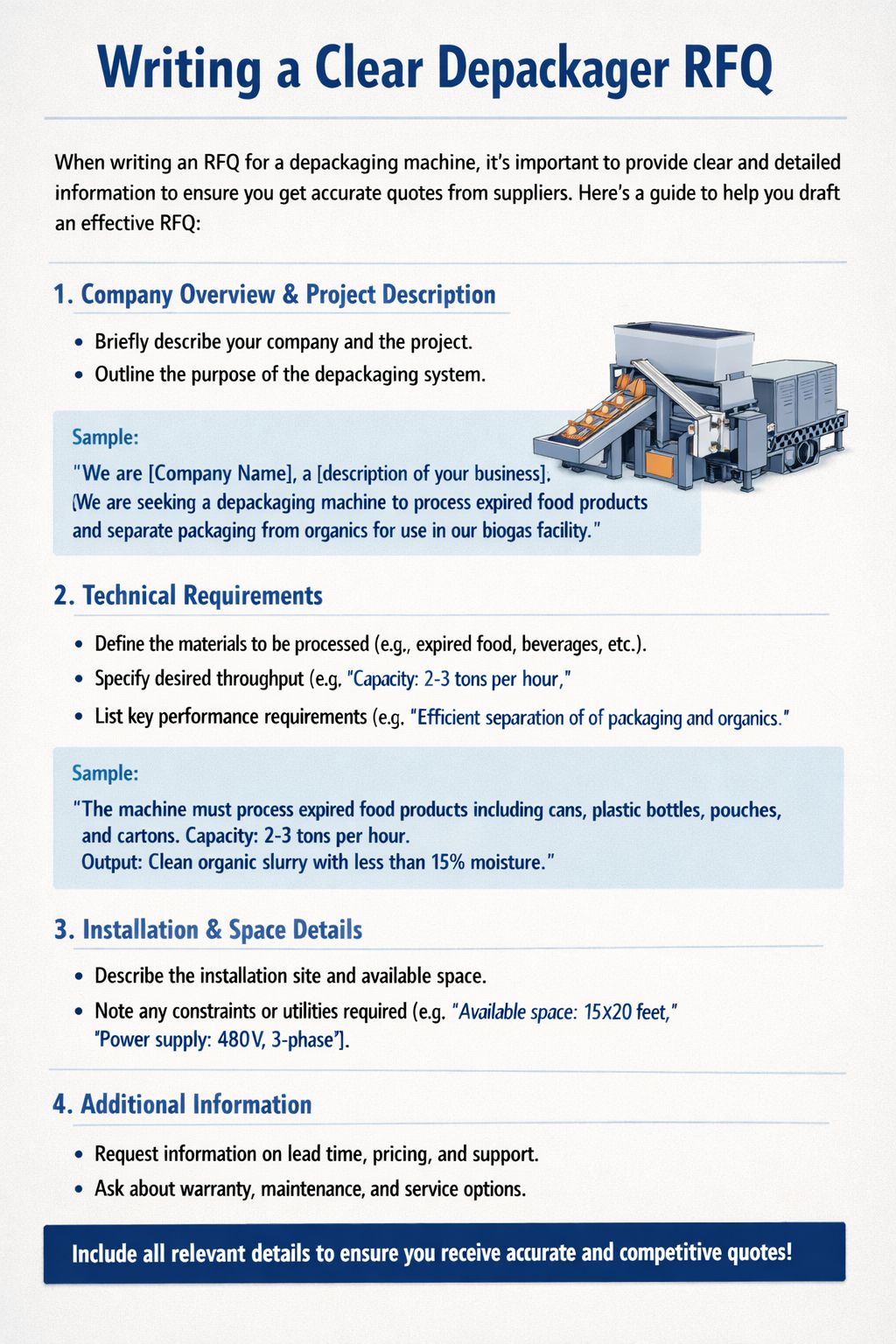
A complete depackager RFQ reads less like a shopping list and more like a technical brief. Each section exists to eliminate a specific kind of ambiguity, so vendors respond with quotes you can actually compare side by side instead of five different interpretations of the same rough idea.
Company Background and Project Context
Start with who you are and why you’re buying. A short overview of your organization, your waste stream composition, and the operational problem you’re solving gives vendors context to tailor their pitch instead of sending a generic brochure. Vendors who understand your mission—whether that’s diverting food waste from landfills or feeding an anaerobic digester—often propose smarter configurations than those working off bare specs alone.
Technical Specifications and Performance Requirements
This is the heart of the document. Spell out throughput capacity in tons per hour, acceptable contamination levels, output purity targets, and the types of packaging materials the machine needs to separate—plastic film, cardboard, glass, metal cans, whatever your stream includes. Quality benchmarks belong here too, since a vendor needs to know whether you’re measuring success by percentage of organic recovery, residual plastic content, or both.
Delivery Schedules and Installation Timelines
Depackagers aren’t plug-and-play. Specify exact delivery windows, installation milestones, and any site-prep requirements the vendor needs to account for, such as electrical capacity or floor loading limits. If your facility has a hard deadline tied to a permit or contract, say so explicitly, since vendors often have multi-month lead times on custom builds.
Terms, Warranties, and Compliance Requirements
Payment terms, warranty length, and compliance standards need their own clearly labeled section. Depackagers often carry one- to three-year warranties on major components, and you’ll want language specifying what counts as normal wear versus a defect. Compliance requirements might include food safety certifications, electrical codes, or emissions standards depending on your jurisdiction.
Response Format and Submission Deadline
Tell vendors exactly how to structure their bid and when it’s due. Specify whether you want pricing broken out by equipment, installation, and ongoing maintenance, or bundled into a single figure. A firm, clearly stated deadline keeps your timeline on track and signals that you run a disciplined procurement process. For more insights on equipment considerations, explore this comparison between depackagers and shredders.
5 Best Practices for Writing a Clear Depackager RFQ
Writing a strong RFQ isn’t about adding more pages—it’s about removing every opportunity for a vendor to guess. These five practices consistently separate RFQs that generate tight, comparable bids from ones that generate confusion. For a deeper understanding of equipment options, consider exploring a comparison of depackager models.
Each one addresses a different failure point in the process, from the moment you draft the document to the moment vendors hit submit.
1. Replace Vague Language With Exact Specifications
“High-capacity depackager” means something different to every vendor who reads it. Replace vague descriptors with numbers: tons per hour, horsepower, footprint in square feet, acceptable moisture content. Ambiguity invites misinterpretation, and misinterpretation produces proposals that don’t match what you actually need.
2. Use a Standardized Template for Every Vendor
Sending every vendor the same structured template makes comparison dramatically easier once quotes come back. It also reduces the administrative load on your team, since you’re not reformatting five different document styles into one comparison sheet. A consistent template signals professionalism, too, which tends to attract more serious, detailed responses from vendors.
3. Time Your RFQ Release Strategically
Releasing your RFQ during a vendor’s slow season—often late summer or early winter in the equipment manufacturing world—can attract more competitive pricing and faster turnaround. Pay attention to market conditions and known vendor capacity before you hit send, since a poorly timed release can mean fewer bids or rushed, lower-quality responses. For more insights, check out this Request for Quotation (RFQ) guide.
4. Keep Communication Channels Open and Consistent
Designate one point of contact for vendor questions and respond promptly to everyone who reaches out. Clear communication channels ensure vendors understand your requirements well enough to respond appropriately, and it prevents one vendor from gaining an information advantage over another through informal side conversations.
5. Set Realistic Response Deadlines
Give vendors enough time to put together a thoughtful, accurate bid—typically two to four weeks for equipment as complex as a depackager. Rushed timelines lead to rushed proposals, and rushed proposals often hide pricing errors or missed specifications that surface only after the contract is signed.
How to Score and Compare Depackager Supplier Quotes
Once bids start arriving, the real work begins. Comparing quotes without a scoring system is how teams end up picking the vendor with the flashiest sales deck instead of the one who actually fits their operation best.
A systematic, documented scoring method turns a subjective decision into an objective, defensible one—something you’ll be grateful for if anyone questions the choice later.
Build a Weighted Scoring Model
Not every criterion deserves equal weight. A weighted scoring model assigns a percentage value to each factor based on how much it matters to your operation. A common breakdown looks something like this: a supplier evaluation checklist can provide more insights into assigning these values effectively.
- Price: 30% of the total score
- Equipment quality and durability: 30% of the total score
- Vendor capability and track record: 40% of the total score
Adjust these percentages to fit your priorities. If your facility runs 24/7 and downtime is catastrophic, you might weight reliability and service response time more heavily than upfront price.
Look Beyond Price to Total Cost of Ownership
The lowest bid on paper isn’t always the cheapest machine over its lifespan. Maintenance contracts, replacement parts, energy consumption, and expected downtime all factor into what a depackager actually costs you over five or ten years.
Consider two hypothetical vendor quotes side by side:
Factor | Vendor A | Vendor B |
|---|---|---|
Upfront Price | $180,000 | $210,000 |
Annual Maintenance | $22,000 | $14,000 |
Expected Lifespan | 8 years | 12 years |
10-Year Total Cost | $400,000 | $350,000 |
Vendor B wins on total cost despite the higher sticker price—a pattern procurement teams see often enough that it’s worth building this math into every evaluation.
Conduct Vendor Interviews and Site Visits
Numbers on a page only tell part of the story. A site visit to a vendor’s manufacturing facility, or a reference call with a customer running the same model, reveals details no spec sheet captures—build quality, service responsiveness, and how the vendor handles problems when they come up.
These conversations also surface red flags early, before you’ve signed a contract and installed a six-figure machine on your floor.
Document Every Decision for Audit Trail Purposes
Keep a written record of your scoring, your reasoning, and the final decision. This documentation protects your team if a vendor disputes the outcome, and it gives future procurement cycles a reference point for what worked and what didn’t.
5 RFQ Mistakes That Cost Procurement Teams Time and Money
Even experienced procurement teams fall into familiar traps when sourcing specialized equipment like depackagers. Recognizing these patterns ahead of time is the fastest way to avoid repeating them.
Most of these mistakes trace back to one root cause: rushing a process that rewards patience and precision.
Here’s where things typically go wrong, starting with the most common culprit: depackaging equipment problems.
1. Incomplete or Ambiguous Specifications
Vague or incomplete specifications top the list of RFQ failures because they ripple through everything downstream. When vendors don’t know your exact contamination tolerance or throughput needs, they guess—and their guesses rarely align with reality. Invest the time upfront to nail down precise, measurable specifications, because every hour spent here saves ten hours of cleanup later.
2. Unrealistic Vendor Response Timelines
A procurement manager at a mid-size composting facility once gave vendors just five business days to respond to a depackager RFQ during the busiest quarter of the year. Only two of seven invited vendors submitted bids, and both quotes contained pricing errors that surfaced during contract review—errors that cost weeks to untangle.
Rushed timelines don’t just shrink your vendor pool. They push qualified suppliers to submit hastily assembled proposals that skip details like maintenance costs or installation logistics, assuming they’ll “work it out later.” Later usually means after the contract is signed, which is the worst possible time to discover a gap.
Procurement teams should set realistic deadlines that balance the need for timely sourcing with the quality of vendor responses. For depackager equipment specifically, two to four weeks gives serious vendors enough runway to pull accurate engineering estimates and pricing from their own supply chains.
A tight deadline might feel efficient on your end, but it almost always backfires by producing bids you can’t trust at face value.
Give vendors room to do the math right the first time, and you’ll spend far less time fixing mistakes after the fact. For instance, understanding the differences between equipment options like the Drycake Twister vs. Tiger Depackager can help vendors make more informed decisions upfront.
3. Chasing the Lowest Price Only
Focusing solely on the initial price quote is one of the easiest ways to blow your budget without realizing it. A cheaper depackager with higher maintenance costs, shorter lifespan, or slower service response time can end up costing more over a decade than a pricier machine built to last. Total cost of ownership should always factor into your final decision, not just the number at the bottom of the quote. For more tips, consider exploring this supplier evaluation checklist guide.
4. Ignoring Long-Term Supplier Relationship Management
Treating a depackager purchase as a one-time transaction instead of the start of an ongoing relationship is a mistake that catches up with procurement teams eventually. Neglecting supplier relationship management can result in missed opportunities for collaboration, priority service during peak demand, and better terms on future parts or upgrades.
Equipment vendors who feel valued as partners tend to go further when something breaks at 2 a.m. on a production deadline. The relationship you build during the RFQ process often predicts how responsive they’ll be once the equipment is installed and running.
Strong supplier relationships also open doors to innovation—vendors are more likely to flag upgrades, retrofit options, or efficiency improvements to customers they consider long-term partners rather than one-off buyers.
A few habits keep these relationships healthy long after the ink dries on a contract:
- Schedule regular check-ins with your depackager vendor, not just service calls when something breaks
- Share operational feedback so the vendor understands how their equipment performs in real-world conditions
- Pay invoices on time and communicate proactively about any changes to your order or timeline
- Loop the vendor in early if you’re planning a facility expansion or capacity increase
Tools That Speed Up the Depackager RFQ Process
Manually tracking RFQs across spreadsheets and email threads works until it doesn’t—usually right around the time you’re juggling five vendor responses with different formats, different deadlines, and different follow-up questions. The right tools turn a chaotic process into a repeatable one. For instance, understanding the differences between Drycake Twister and Tiger Depackager can help streamline vendor selection.
E-Procurement Platforms for Centralized RFQ Management
E-procurement systems provide a centralized platform for managing the entire RFQ process, from initial creation through contract award. These systems often include template management, automated workflows, and real-time collaboration tools that let your cross-functional team weigh in without endless email chains.
Centralizing the process this way can reduce processing times significantly and improve transparency throughout the procurement cycle—something that matters a lot when you’re justifying a six-figure equipment purchase to finance or leadership. In the realm of procurement, a Request for Quotation (RFQ) serves as a critical document for involving stakeholders.
RFQ Software With Automated Scoring Models
Dedicated RFQ management software simplifies the creation, distribution, and evaluation of your depackager quotes. Features like customizable templates, automated scoring models, and vendor performance tracking take the manual math out of comparing bids, which reduces the chance of human error creeping into your weighted scoring system.
Platforms built specifically for procurement teams, including Oppizi, help standardize this process so your evaluation criteria stay consistent from one RFQ to the next instead of being reinvented each time a new purchase comes up.
Using Data Analytics to Track Vendor Performance
Data analytics tools let procurement teams track vendor performance metrics over time—delivery accuracy, quality ratings, pricing competitiveness—so your next depackager purchase benefits from everything you learned on this one. Automation also reduces administrative burdens like data entry and document distribution, freeing your team to focus on strategic work like vendor negotiation.
Over multiple procurement cycles, this data becomes a genuine competitive advantage, letting you spot which vendors consistently deliver and which ones only look good on paper.
Run a Tighter, Smarter Depackager Supplier Selection Process
A detailed, well-structured RFQ checklist isn’t extra paperwork—it’s the difference between a depackager that runs reliably for a decade and one that becomes a recurring headache. Build your criteria early, score every bid the same way, and treat your chosen vendor as a long-term partner rather than a one-time transaction.
Frequently Asked Questions
What’s the Difference Between an RFQ and an RFP for Equipment Purchases?
An RFQ works best when you already know your exact specifications and price is the main deciding factor among comparable vendors. An RFP fits more complex purchases where you need vendors to propose custom solutions, such as an integrated waste processing system with multiple connected components.
How Long Should a Depackager Supplier RFQ Process Take?
Plan for roughly six to ten weeks from drafting your RFQ to signing a contract. That timeline typically includes two to four weeks for vendors to respond, plus time for evaluation, site visits, and final negotiation.
What Evaluation Criteria Matter Most When Comparing Depackager Vendors?
Throughput capacity, output purity, total cost of ownership, and vendor track record consistently rank as the highest-priority criteria. Weight these based on your specific operational priorities, since a facility focused on uptime will score differently than one focused purely on upfront cost. For a deeper understanding of the differences between equipment types, consider this comparison of depackagers.
Should Price Be the Deciding Factor in a Depackager RFQ?
Price matters, but it shouldn’t be the only factor. A vendor with a proven track record and higher-quality equipment often delivers better long-term value than the lowest bidder, especially once maintenance costs and downtime risk enter the picture.
How Do I Keep RFQ Evaluations Fair and Defensible?
Use a documented, weighted scoring model applied consistently across every vendor, and keep written records of your reasoning at each stage. This creates an audit trail that protects your team if a vendor disputes the outcome and gives future procurement cycles a reliable reference point. For more insights, consider exploring top depackaging equipment problems and how leading operators address them.

On-Site Food Digesters vs. Biogas Systems: Which Is Better for Hotels and Hospitality?
Spread the loveHave you ever watched the bins pile up behind your hotel kitchen and wondered where all that money is going? Spoiled ingredients, plate scraps, and prep waste add up fast. And you pay steep fees to haul it all to the landfill. Here’s a number that surprised me the first time I saw […]

Using the Commercial Insurance Renewal Process to Get the Best Cover and Deals
Initiating your commercial insurance renewal process early provides opportunities to negotiate terms, ensure coverage aligns with your business’s evolving needs, and explore competitive quotes. This proactive approach can protect against premium increases and coverage gaps, ultimately helping to secure the best deals for your business…

10 Ways to Avoid Wastage of Food
Discover how cutting food waste can save your family up to $1,500 annually. Learn key strategies for meal planning, proper storage, and understanding expiration labels. Implement these tips to keep your kitchen organized and your wallet full while reducing your environmental footprint…

Harnessing the Potential of Organic Fertilisers in Italian Agriculture
Spread the loveUsing Organic Fertilisers to their Full Potential in Italy’s Farms Nitrogen is a crucial element in agriculture, playing a vital role in plant growth and development. Italy, with its rich agricultural heritage and commitment to sustainable farming practices, has immense potential for the use of organic fertilisers in agriculture. Organic fertilisers, derived from […]